
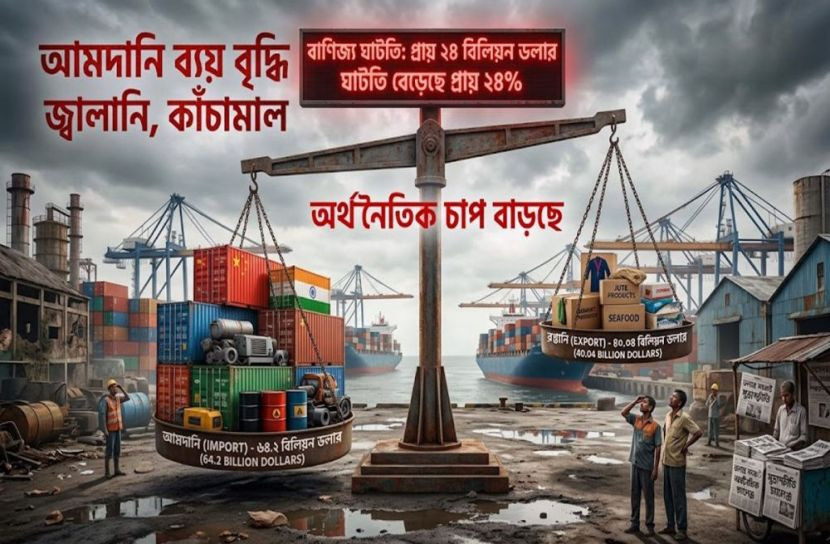
The latest statistics of Bangladesh Bank indicate the alarming situation in the country’s foreign trade. In the first 11 months (July to May) of FY 2025-26, import expenditure increased significantly, but export earnings did not increase at the same rate. As a result, the deficit in foreign trade has increased to about 24 billion dollars. According to the updated data of the Balance of Payments (BOP) published by Bangladesh Bank, the country’s trade deficit at the time of discussion stood at 23.98 billion US dollars. The deficit was $19.38 billion at the same time a year ago. That is, the deficit has increased by about 24 percent in one year.
Why is the trade deficit increasing?
According to economic analysts, the country’s import expenditure has increased due to the increase in the prices of fuel, industrial raw materials and other import-dependent goods in the international market. On the other hand, exports have not increased at the expected rate due to global market challenges, changes in demand and competition. As a result, the gap between imports and exports has widened.
Increase in imports
According to the data of Bangladesh Bank, in the first 11 months of the fiscal year 2025-26, Bangladesh imported goods worth 64.2 billion dollars. This amount was 60.25 billion dollars in the same period of the previous financial year. As a result, the import cost increased by 6.3 percent. According to experts, keeping industrial production running, fuel imports and higher prices of raw materials have played a major role in increasing the cost of imports.
Downward trend in export earnings
At the same time, the country’s total product export income was 40.04 billion dollars, which is about 2 percent less than 40.87 billion dollars in the same period of the previous fiscal year.
This decline in export earnings and high growth in imports is seen as one of the main reasons for widening the trade deficit.
Current account is still negative
Current Account Balance is an important indicator of a country’s regular foreign transactions. As such, if there is a surplus, the dependence on foreign debt is reduced, and if there is a deficit, additional financing is required to meet it. According to the data of Bangladesh Bank, the current account deficit decreased to 300 million dollars at the end of May of the financial year 2025-26. This deficit was 780 million dollars in the same period of the previous financial year.
Positive position in overall foreign exchange
Although the trade deficit widened, the overall foreign exchange or overall balance showed positive progress.
In the first 11 months, the surplus in this index stood at 4.02 billion dollars. But in the same period of the previous financial year, this index was in deficit of 115 million dollars.
According to analysts, the improvement in overall transactions is due to increase in remittance inflows and some positive changes in foreign remittances.
Big growth in remittances
In the first 11 months of the fiscal year, expatriate Bangladeshis sent remittances equivalent to 3,277 million dollars.
In the same period of the previous financial year, the amount of remittance was 2 thousand 750 million dollars. As a result, the growth in this sector has been 19.1 percent, which is considered positive for the country’s foreign exchange reserves and economy.
Foreign direct investment has declined
Foreign Direct Investment (FDI) inflows to Bangladesh have also seen a downward trend.
In the first 11 months of the fiscal year 2025-26, FDI inflows to the country amounted to $131 million, while this amount was $155 million in the same period of the previous fiscal year.
Foreign capital is also leaving the stock market
Not only direct investment but also portfolio investment showed a negative picture. According to the data of Bangladesh Bank, foreign investors have withdrawn net 17.5 million dollars from the stock market during the period under discussion. This negative position was 13.4 million dollars in the same period of the previous financial year.
Economists’ observations
According to experts, emphasis should be placed on diversification of exports, expansion of new markets, reduction of production costs and reduction of dependence on high-priced imports to restore foreign trade balance. At the same time, if foreign investment attraction and industrial competitiveness are not increased, the pressure of trade deficit in the long term may have a deeper impact on the economy.